

Marketplace fraud prevention works best when treated as a set of product surfaces, not a bolted-on filter. Identity, listings, payments, communications, and disputes each get their own controls, staged verification thresholds, and owners. Layer device signals, machine learning scoring, and payment controls on top, and the rest of this playbook shows you the checklist, KPIs, and integration points to build it.
TL;DR:
- Effective fraud detection requires layered controls across identity, listings, payments, communication, and disputes, with staged verification thresholds based on risk.
- Key fraud patterns include fake listings, triangulation scams, account takeovers, synthetic identities, and overpayment schemes, each leaving distinct log signatures.
- Behavioral analytics and device signals, combined with machine learning models, can detect fraud rings while minimizing false positives and false negatives.
- Implementation benefits from phased rollout: starting with payment checks and device fingerprinting, then progressing to staged KYC, ML scoring, and signal sharing within 90 days.
- Regular KPI tracking, incident triage, and cross-platform signal sharing are essential for measuring success and quickly responding to fraud incidents.
Table of Contents
- What Are the Most Common Types of Marketplace Fraud?
- Trust & Safety Pillars: A Productized Framework
- Technical Controls: Device Signals, ML Scoring, and Payment Defenses
- Implementation Checklist: A Prioritized 30 to 90 Day Roadmap
- How Do You Measure Marketplace Fraud Prevention Success?
- Incident Response: Triage, Evidence, and Takedown
- Where Anti-Detect Browser Signals Fit Into Your Stack
- Dispute Resolution as a Product Surface
- Merchant and Seller Onboarding Best Practices
- Buyer Education and Awareness Programs
- Cross-Platform Fraud Coordination
- Regulatory Compliance and Legal Considerations
- Publisher Perspective: Product-First Trust and Safety
- Try heretic's Device and Network Verification
- Sources
What Are the Most Common Types of Marketplace Fraud?
Fraud teams face a recurring set of attack patterns, and each leaves a distinct fingerprint in your logs.
Fake listings advertise items that don't exist, often at prices well below market to force fast decisions. Triangulation fraud uses stolen payment cards to buy real goods, ships them to a legitimate buyer, and pockets the payment while the cardholder disputes the charge later. Account takeover (ATO) hijacks a real seller or buyer profile, usually through credential stuffing, then drains stored balances or lists fraudulent items using the account's trust history.
Synthetic identities stitch together real and fabricated data to pass basic verification and build a clean track record before striking. Overpayment scams send a check or transfer for more than the asking price, then ask for a refund of the difference before the original payment bounces. Refund and return abuse exploits generous policies by returning empty boxes, used items, or counterfeits. Payout hijack redirects seller earnings by changing bank details after an account compromise. Friendly fraud happens when a legitimate buyer disputes a valid charge with their card issuer instead of contacting the seller.
Detection signals overlap across these patterns:
- IP and geolocation mismatches between account registration, login, and shipping address
- Device or browser fingerprint reuse across accounts flagged for prior bans
- Shipping addresses that don't match billing addresses, especially freight forwarders
- Listing prices sitting notably below comparable active listings
- Message velocity spikes right before a payment or shipping request
A triangulation scheme, for example, often shows a new seller account, a shipping address that changes with every order, and a refusal to use in-platform messaging.
Trust & Safety Pillars: A Productized Framework
Marketplace integrity holds up best when you organize it around six pillars, each with its own owner, metrics, and release cadence. This mirrors the six-pillar trust-and-safety framework that separates identity, listings, reviews, communications, payments, and disputes into distinct product lines.
- Identity controls who can transact and at what trust level, using staged KYC/KYB that escalates verification only when risk rises.
- Listings filters catch fake or prohibited items before they go live, using pre-publish rules and price-anomaly detection.
- Reviews integrity stops fake ratings and review-gating schemes that inflate seller trust artificially.
- Communications routes buyer-seller messages through masked channels to catch off-platform payment requests before they succeed.
- Payments enforces AVS, CVV, and velocity limits at the transaction layer.
- Disputes gives both sides a bounded, evidence-driven resolution path instead of an open-ended support queue.
Staged verification means a new account might only need an email and phone number to browse and list low-value items. Push a payout above a set threshold, list in a regulated category like electronics or pharmaceuticals, or trigger a risk score spike, and the system should demand government ID or business registration before the action completes.
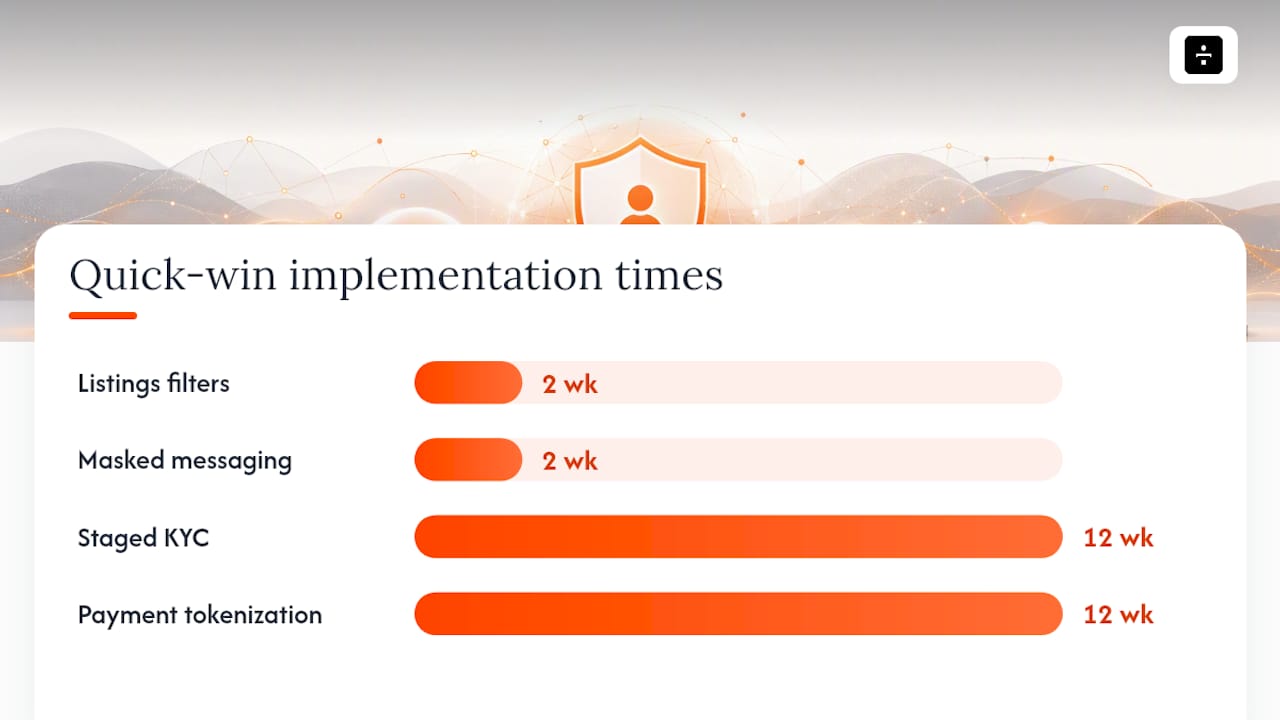
Quick wins differ sharply by pillar. Listings filters and masked messaging ship in two weeks with existing infrastructure. Staged KYC workflows and payment tokenization take a full quarter because they touch onboarding flows, legal review, and payment processor integrations.
Technical Controls: Device Signals, ML Scoring, and Payment Defenses
Fraud detection at the transaction layer depends on stacking multiple signal types so no single evasion technique defeats the whole system.
Device and network signals form the first layer:
- Browser and hardware fingerprinting to catch device reuse across banned accounts
- Anti-detect browser heuristics that flag spoofed user agents, mismatched screen resolutions, or inconsistent timezone data
- Packet-level and network behavior analysis to detect proxy chains or residential proxy farms
- Hashed device ID storage, which lets you match repeat offenders re-registering under new emails without storing raw identifiers
Behavioral analytics and ensemble machine learning models layer on top, scoring session patterns, transaction velocity, and buyer-seller graph relationships to surface fraud rings that single-account review would miss. Visa's own pilots show that AI-driven risk modeling can detect substantially more fraud while keeping false-positive rates low, which matters because an overly aggressive model just pushes good sellers away. Retrain these models on a monthly cadence at minimum. Fraud patterns shift fast enough that a static model decays within weeks.
Payment controls round out the stack: AVS and CVV matching, 3DS/SCA challenges for higher-risk transactions, tokenization so raw card data never touches your servers, escrow for high-value peer-to-peer sales, and payout re-verification whenever bank details change.
Pro Tip: Combine behavioral analytics with device fingerprinting to catch fraudulent sessions before checkout, then let post-purchase automation handle evidence capture. That sequencing raises dispute win rates without slowing down legitimate buyers.
Post-purchase, automated holds on high-risk orders and dispute automation with built-in evidence capture cut the manual review load significantly, since analysts spend time only on the ambiguous cases the system can't resolve.
Implementation Checklist: A Prioritized 30 to 90 Day Roadmap
Roll this out in three phases so engineering and trust teams aren't rebuilding the payment stack and the verification flow in the same sprint.
- Days 1 to 30: Deploy AVS/CVV checks and 3DS challenges on existing payment rails, add device fingerprinting to signup and login, build pre-publish listing filters for price anomalies and banned keywords, mask in-platform messaging, and set basic rate limits on new-account actions.
- Days 30 to 60: Build staged KYC/KYB workflows tied to risk thresholds, pilot an ML scoring model on a subset of transaction categories, integrate escrow or secure payment holding, and add payout re-verification after any bank detail change.
- Days 60 to 90 and beyond: Join shared fraud signal networks with other merchants, move toward zero-trust session architecture, formalize AML and PCI DSS v4.0.1 scope with your compliance team, and schedule recurring red-team testing against your own verification flows.
Roll out new controls against one or two listing categories first, watch your KPIs for two full cycles, and tune thresholds before expanding platform-wide.
| Phase | Focus | Primary Owner |
|---|---|---|
| Days 1 to 30 | Payment checks, device fingerprinting, listing filters | Engineering |
| Days 30 to 60 | Staged KYC, ML pilot, escrow integration | Trust & safety + product |
| Days 60 to 90+ | Shared signal networks, zero-trust, compliance scope | Security + legal |
How Do You Measure Marketplace Fraud Prevention Success?
Five metrics tell you whether your controls are actually working, not just generating alerts.
- Ban-evasion rate, tracked through hashed device and ID matches, shows how often banned users successfully re-register
- Off-platform leakage rate, measured via sampled messaging audits, shows how many transactions escape your payment protections
- Median dispute resolution time signals whether your evidence capture and SLA structure actually work under load
- Chargeback percentage of GMV is the bottom-line cost of fraud that got past every earlier control
- False-positive rate tells you how much legitimate business your filters are blocking
Instrument these with dashboards that pull from your fingerprinting logs, payment processor webhooks, and dispute case data. Set alert thresholds so a spike in any single metric, not just the composite fraud rate, triggers a review. A five-point drop in ban-evasion rate translates directly into retained sellers and preserved GMV, which is the argument that gets budget approved.
Incident Response: Triage, Evidence, and Takedown
When a fraud incident surfaces, speed determines whether you keep the chargeback or eat it.
- Immediate triage: snapshot the session data, freeze any pending payout, and preserve every message in the thread before the account can delete anything
- Escalation rules: low-confidence signals route to automated holds with a 24-hour review SLA; high-confidence matches (repeat device ID, known fraud ring) trigger immediate account suspension
- External coordination: work directly with your payment network on chargeback disputes, and refer clear criminal activity to law enforcement or report it through ReportFraud.ftc.gov
- Communications: use a pre-approved template that documents the timeline and evidence trail, since a fast, thorough response materially improves your chargeback dispute odds
Where Anti-Detect Browser Signals Fit Into Your Stack
Device and network verification sits squarely in the identity and payments pillars. An approach combining packet analysis, system benchmarking, and network behavior comparison can catch a gap between a user's claimed device and what their traffic actually shows, the exact discrepancy pattern behind synthetic accounts and ban evasion.

Engineering teams typically integrate through a lightweight script tag collector or a challenge widget triggered at staged verification points, such as payout changes or high-value listings. Signup rules let you encode exactly when that stronger check fires.
Dispute Resolution as a Product Surface
Treat disputes like any other product feature: define the SLA, build the workflow, and automate evidence capture instead of relying on ad hoc support tickets. Marketplaces that productize dispute resolution with fast response windows and default outcomes for low-value cases see measurably fewer chargebacks and off-platform escalations.
Structure the workflow in three stages. First, automated evidence collection grabs message logs, shipping confirmations, and photos at the moment a dispute opens, before either party can alter the record. Second, a risk-ordered queue routes high-value or ambiguous disputes to human reviewers while resolving clear-cut, low-value cases through pre-set rules, such as automatic refunds under a fixed dollar threshold when tracking shows no delivery.
Third, set explicit SLA targets: a 24-hour first response, a 72-hour resolution target for standard cases, and a defined escalation path for anything that breaches those windows. Publish these targets internally so support and engineering share the same accountability.
The evidence capture piece matters more than most teams realize. When a chargeback reaches the payment network, the marketplace that already has timestamped messages, delivery confirmation, and photos assembled wins the dispute far more often than one scrambling to reconstruct a timeline after the fact. Build the capture pipeline once, and every future dispute inherits it automatically.
Merchant and Seller Onboarding Best Practices
Onboarding is your first and cheapest fraud checkpoint, because every control you skip here has to be caught later at higher cost.
Start with staged verification: a lightweight identity check for browsing and low-value listing, then step up to government ID or business registration before a seller can accept payouts or list in regulated categories. This staged KYC pattern preserves signup conversion while still gating the actions that carry real risk.
Collect banking details only after a seller clears identity verification, and require re-verification any time those details change. Cross-check business registration numbers against public registries where available, especially for B2B categories or high-value goods. Run new seller accounts through the same device fingerprinting used at buyer signup. A "new" seller account sharing a device hash with three previously banned accounts should trigger manual review before its first listing goes live, not after the first complaint.
Set a probationary period for new sellers, capping transaction volume or payout speed until they build a track record. This limits the blast radius if a synthetic identity slips through initial checks, and it gives your ML scoring model enough transaction history to evaluate the account properly.
Buyer Education and Awareness Programs
Technical controls stop most fraud, but a buyer who moves a conversation off-platform bypasses every protection you've built. The FTC's core guidance to buyers is to use secure in-platform payment methods and preserve transaction records rather than wiring money or paying with gift cards outside the marketplace.
Build that guidance directly into your product instead of leaving it in a help article no one reads. Surface a warning the moment a message contains payment-related keywords alongside a request to move to email or text. Show a simple trust indicator on seller profiles, verified identity, transaction history, response time, so buyers can make an informed decision without reading a policy page.
A short onboarding tooltip explaining why in-platform payment protects both parties does more than a lengthy terms-of-service clause buried at signup. Reinforce it again at the payment step, right when a buyer might be tempted to accept a "discount for paying outside the app."
Cross-Platform Fraud Coordination
Fraud rings rarely limit themselves to one marketplace. A seller banned from your platform for triangulation fraud often reappears on a competitor within days, using the same device and payment patterns.
Shared fraud signal networks let merchants pool anonymized identifiers, hashed device IDs, flagged payment tokens, known fraud patterns, without exposing raw customer data. Combining network intelligence across merchants substantially improves detection of repeat offenders and coordinated fraud rings that look isolated from any single platform's data.
Practically, this means joining or building consortium-style data sharing where legally permissible, and structuring your own fraud data so it's exportable in a standard format if you join one later. Even without a formal network, tracking device fingerprint hashes lets you catch the same actor returning under a new account, which is the single most common ban-evasion pattern marketplaces face.
Regulatory Compliance and Legal Considerations
Fraud prevention controls don't operate in a legal vacuum. PCI DSS v4.0.1 governs how you handle card data, and tokenization plus 3DS reduce your compliance scope significantly by keeping raw card numbers off your servers. Security frameworks for online marketplaces increasingly treat PCI compliance, KYC/KYB, and escrow as baseline requirements rather than optional hardening.
GDPR and similar data protection regimes constrain how you store device fingerprints and identity verification data, which is why hashing device IDs rather than storing raw identifiers matters both for fraud detection and for compliance. AML obligations apply once your payout flows resemble money transmission, particularly for marketplaces enabling peer-to-peer payments at scale, and the threshold for when AML scope kicks in varies by jurisdiction and payment volume.
Work with legal counsel to map exactly which regulations apply to your specific payment flows and user base before building compliance into your roadmap; treating this as an engineering afterthought instead of a design input is the most expensive mistake fraud teams make.
Publisher Perspective: Product-First Trust and Safety
Treating trust and safety as a bolted-on filter guarantees friction for good sellers and gaps for bad ones. Product-level SLAs, staged verification, and measurable KPIs give you both conversion and control. Marketplaces winning this fight aren't running more rules; they're running better-instrumented ones.
— heretic
Try heretic's Device and Network Verification
Every layer in this playbook depends on knowing whether a device and its network traffic actually match what an account claims. That's the specific gap heretic closes: packet analysis and performance benchmarking catch the mismatch between a claimed device profile and its real behavior, the pattern behind ban evasion and synthetic account creation.

Engineers can start with the script tag collector for a fast baseline integration, or add the challenge widget at staged verification points like payout changes or high-risk listing categories. Both connect to the same signal pipeline, so you can start narrow and expand coverage as you tune thresholds. Visit Heretic to review the sandbox trial and see which integration path fits your current stack.
Sources
- The Merchant's Guide to eCommerce Fraud Detection - Merchant Fraud Journal
- Buying from online marketplaces | FTC
- Marketplace Trust & Safety Playbook: Fraud Prevention & KYC (2026 Guide) | TechVinta Blog
- How Visa helps prevent eCommerce fraud