

The most effective posture against synthetic identity fraud combines authoritative PII verification (eCBSV, credit bureau cross-checks), device and network intelligence, and behavioral or graph analytics into one continuous program. No single check catches a fabricated identity that has been cultivated for months. Prioritize incubation monitoring over point-in-time approval decisions, since that is where synthetic identity detection actually pays off.
TL;DR:
- Combining authoritative verification, device intelligence, and behavioral analytics provides the strongest defense against synthetic identity fraud.
- Detection should focus on incubation behavior over time, as fraudsters spend months building credibility before bust-out activity.
- Multi-layered data sources, including SSN verification, device fingerprinting, and third-party fraud networks, are necessary to identify fabricated identities.
- Machine learning techniques like graph analysis and anomaly detection help uncover clusters and outliers that indicate synthetic identities.
- Continuous monitoring and clear escalation processes are essential since most fraud signals emerge during incubation, not at initial application.
Table of Contents
- What Synthetic Identity Fraud Is and Why It Beats Standard Checks
- How Fraudsters Build and Incubate a Synthetic Identity
- Red Flags That Actually Predict a Synthetic Identity
- Detection Methods and Data Sources to Combine
- Where Machine Learning Actually Helps, and Where It Doesn't
- The Operational Playbook: Block, Step Up, Monitor, Escalate
- Measuring Whether Your Program Actually Works
- How Device and Network Measurement Fits the Bigger Picture
- Where Heretic Fits in a Layered Detection Program
- Where Heretic's Measurement Approach Fits the Detection Stack
- Sources
What Synthetic Identity Fraud Is and Why It Beats Standard Checks
Synthetic identity fraud is the use of a combination of personally identifiable information to fabricate a person or entity for financial gain, rather than the theft of one real person's complete identity. The Federal Reserve's working definition splits PII into primary elements, typically a Social Security number, and supplemental elements like a name, date of birth, or address that get mixed and matched around it. That distinction matters for detection design.
A stolen-identity case has a victim who eventually notices a strange charge and reports it. A synthetic identity has none. Nobody calls the bank because the Social Security number belongs to a child, a deceased person, or a randomly generated number that happens to pass a basic checksum. The file looks brand new, not stolen, which is precisely why bureau-only screening misses it.
This creates two structural problems for detection teams:
- A synthetic identity often has a thin or nonexistent credit history, so "no hits" reads as low risk instead of high risk.
- Fraudsters spend months or years building credibility before extracting value, meaning the fraud signal is temporal, not transactional.
Detection has to shift from "does this person exist" to "does this identity's behavior over time look human."
How Fraudsters Build and Incubate a Synthetic Identity
Construction methods vary, but they fall into two broad categories, and knowing which one you're facing changes what red flags to expect.
- Manipulated identities start with a real person's data, usually a stolen or purchased Social Security number, paired with a fabricated name, address, or date of birth. These are harder to catch at origination because part of the file is genuinely real.
- Manufactured identities are built from scratch: a synthetic Social Security number generated to pass format checks, combined with invented biographical details and often a real but unrelated address, sometimes a vacant property or a mail drop.
- Incubation follows immediately. The fraudster applies for a secured card, a retail credit line, or gets added as an authorized user on someone else's account to inherit tradeline history.
- Small, consistent repayment behavior builds a credit score over six months to several years, sometimes longer, specifically to raise limits and unlock better products.
- Bust-out happens once limits are high enough. Balances get maxed across multiple accounts in a short window, then the identity goes dormant permanently.
That gap between step 3 and step 5 is the entire opportunity for detection. Fraud teams that only watch for anomalies at bust-out are watching the wrong end of the timeline.
Red Flags That Actually Predict a Synthetic Identity
Individually, most of these signals are weak. Stacked together, they become reliable. Feed them into a rules engine or a model's feature set rather than treating any one of them as a standalone decision.
- A Social Security number issued before the applicant's stated birth year, or one never associated with any credit activity until recently.
- Multiple applications sharing an address, phone number, or email pattern across supposedly unrelated identities.
- A credit file with no history before a certain date, followed by unusually fast, unusually clean payment behavior.
- The same device fingerprint, browser configuration, or IP address reused across accounts opened weeks or months apart.
- Government ID documents that pass a static image check but fail liveness or fail to match claimed device metadata.
- Authorized-user additions on accounts with no plausible personal relationship between primary and secondary holders.
Digital footprint signals like email age, phone number reputation, and IP consistency tend to separate real applicants from fabricated ones faster than document review alone, since a genuine person's digital trail is almost never this clean or this new.
Pro Tip: Tune thresholds around velocity, not just presence. A shared IP address on one application is noise. The same IP address across five applications in a week is a pattern worth a manual review queue.
Detection Methods and Data Sources to Combine
No individual data source resolves synthetic identity fraud on its own. A multi-layered verification approach that cross-references authoritative records, device telemetry, and behavior across time is what actually holds up in production.
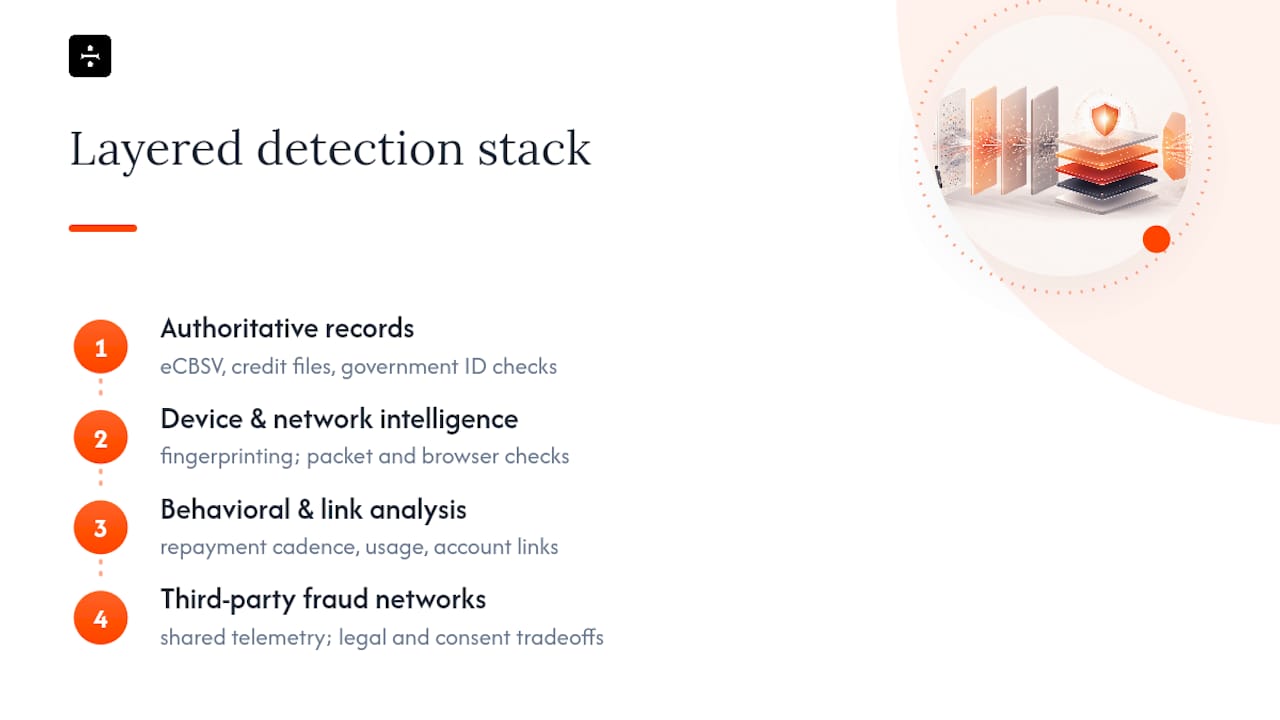
Authoritative identity verification anchors the stack. The Social Security Administration's Electronic Consent Based SSN Verification service (eCBSV) confirms whether a name, date of birth, and Social Security number combination matches SSA records, closing the gap that a synthetic manufactured SSN exploits. Credit bureau file-depth checks and government ID document verification round this layer out.
Device and network intelligence catches what identity documents cannot. Device fingerprinting flags repeat hardware across supposedly distinct applicants. Packet-level and browser-spec consistency checks expose cases where claimed device or network properties do not match observed behavior, a strong signal when an applicant is running automation or an anti-detect browser to fabricate a plausible digital footprint at scale.
Behavioral analytics and cross-product link analysis watch what happens after approval, tracking repayment cadence, product usage patterns, and connections between accounts that share subtle attributes a human reviewer would never spot manually.
Third-party fraud-network intelligence adds visibility your own portfolio cannot provide alone, since shared telemetry across institutions surfaces identities already flagged elsewhere. This layer carries real privacy and consent tradeoffs, and legal review of data-sharing agreements belongs early in the design process, not after a pilot is already running.
Where Machine Learning Actually Helps, and Where It Doesn't
Graph-based link analysis is the single highest-value ML technique here, because synthetic identities rarely act alone. They cluster around shared addresses, devices, phone numbers, and authorized-user relationships, and a graph model surfaces those clusters far faster than rules-based matching.
The strongest pipelines run in two stages: unsupervised anomaly detection identifies unusual clusters or outlier behavior first, then a supervised model scores flagged cases against confirmed fraud labels. Explainability tools like SHAP matter operationally, since a fraud analyst needs to see why a case scored high before escalating it, not just the score itself.
- Use graph embeddings to detect shared-attribute networks across accounts that look unconnected on the surface.
- Layer anomaly detection ahead of supervised classifiers to catch novel patterns that labeled training data hasn't seen yet.
- Keep a human-in-the-loop review step before account closure or reporting, since false positives carry real customer-relationship cost.
Label scarcity is the persistent obstacle. Confirmed synthetic identity cases are rare relative to overall application volume, and most only get confirmed at bust-out, months after origination. That imbalance pushes teams toward semi-supervised and anomaly-first architectures rather than pure supervised learning.
A hybrid graph autoencoder and ensemble approach recently reported strong performance metrics including F1 score, precision, and recall on a real-world dataset, according to research published in the International Journal of Computational Intelligence Systems. That's a promising signal for graph-based methods on sparse fraud data, though the researchers themselves flag that results depend heavily on dataset composition and label quality, meaning your own portfolio's performance will vary from the paper's benchmark.
The Operational Playbook: Block, Step Up, Monitor, Escalate
Detection only matters if it changes what happens at each stage of the account lifecycle. Here's the sequence that holds up in practice.
- Risk-based onboarding. Apply light friction to low-risk applicants and reserve step-up verification, like a challenge widget requiring device or liveness confirmation, for applications carrying two or more red flags from your indicator list.
- Continuous monitoring, not one-time approval. Re-score accounts periodically during the first 12 to 24 months, since incubation behavior only becomes visible over time, not at the moment of application.
- Escalation matrix. Set clear thresholds for automated review, human investigation, and formal reporting. Traditional fraud models missed a large majority of likely synthetics in some tested scenarios, which is the strongest argument for keeping trained analysts in the review loop rather than relying on automated scoring alone.
- Feedback and intelligence sharing. Label confirmed bust-outs immediately, feed them back into model retraining, and share indicators of compromise with partner fraud networks where your data-sharing agreements allow it.
Pro Tip: Track incubation velocity as its own metric, meaning how fast a new account's credit utilization and payment behavior change. A sudden acceleration after months of quiet, consistent activity is one of the most reliable pre-bust-out signals available.
Measuring Whether Your Program Actually Works
A synthetic identity program needs the same rigor as any other risk model, tracked over time rather than judged on a single quarter.
| Metric | What it tells you |
|---|---|
| Precision and recall | Whether flagged cases are actually fraud, and how many real cases you're missing |
| False-positive rate | Manual-review burden and customer friction cost |
| Time-to-detection | How long incubation runs before your controls catch it |
| Estimated prevented loss | Rough dollar impact, benchmarked against portfolio-wide loss trends |
Validate with holdout testing and simulated incubation scenarios rather than trusting live performance alone, since confirmed fraud labels arrive slowly and unevenly. Reporting prevented loss for a rare event is inherently approximate. Compare flagged-and-blocked account behavior against a matched control group that passed review, and use that gap to estimate program ROI rather than presenting a single point figure as fact.
How Device and Network Measurement Fits the Bigger Picture
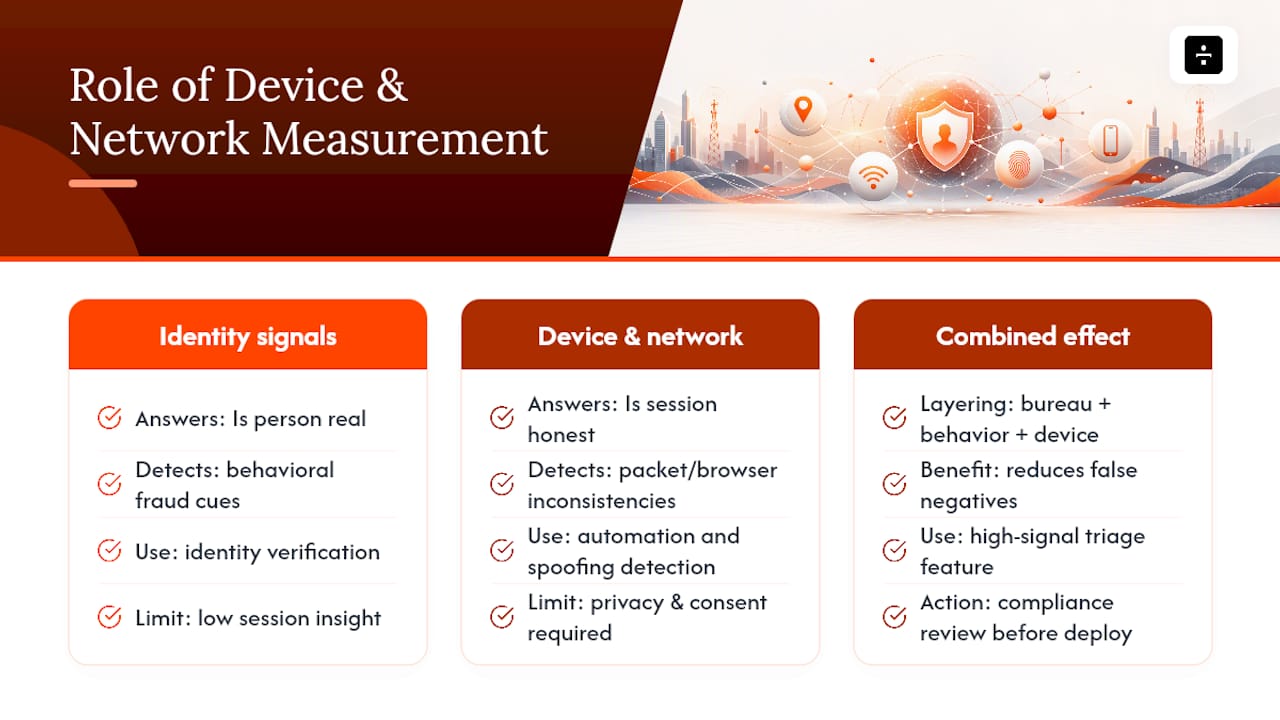
Identity verification and behavioral analytics answer "is this person real." They rarely answer "is this session honest." Packet analysis and browser-spec consistency checks close that gap by exposing when claimed device or network properties don't match observed behavior, a pattern common among synthetic identity operations running automation at scale.
Layered against credit bureau and behavioral signals, this reduces false negatives and gives analysts a high-signal feature for triage. Privacy and consent obligations still apply here, and compliance teams should review data handling before deployment.
Where Heretic Fits in a Layered Detection Program
A certain anti-detect browser verification platform focuses on the layer most identity-verification stacks skip: verifying whether a device and network actually match what an applicant claims. Combining packet analysis, hardware and network fingerprinting, and active session challenges through phone sensor integration, this service gives fraud and security teams a way to catch account misrepresentation that credit bureau checks and document review can't see on their own.

For engineering teams evaluating this as an added layer, integration starts with the collector options and result documentation for available signals, the script tag or npm package for implementation, and the privacy and retention policy for how measurement data is handled. Teams building step-up flows around accumulated risk indicators can review signup rules for configuring when a challenge should trigger. Start with a sandbox trial at Heretic to see how device and network discrepancy detection performs against your current onboarding flow before committing to a full integration.
Where Heretic's Measurement Approach Fits the Detection Stack
Packet analysis and browser-spec consistency checks answer a question identity documents cannot: does this session's actual behavior match what the applicant claims. Layered against credit bureau data and behavioral analytics, that reduces false negatives and gives fraud analysts a concrete triage signal instead of a probability score alone. Privacy and consent obligations still govern how this data gets collected and stored, and legal or compliance review belongs early in any deployment, not as an afterthought once a pilot is already live.
— heretic
Sources
Start with the Federal Reserve's synthetic identity fraud definition, the mitigation toolkit, and Plaid's fraud explainer for grounding, then review heretic's measurement documentation for implementation detail.
- Synthetic Identity Fraud Defined | FedPayments Improvement
- Synthetic identity fraud | Plaid
- Synthetic Identity Fraud Detection Using Federated Hybrid Graph Autoencoder—An AI-Based Approach